
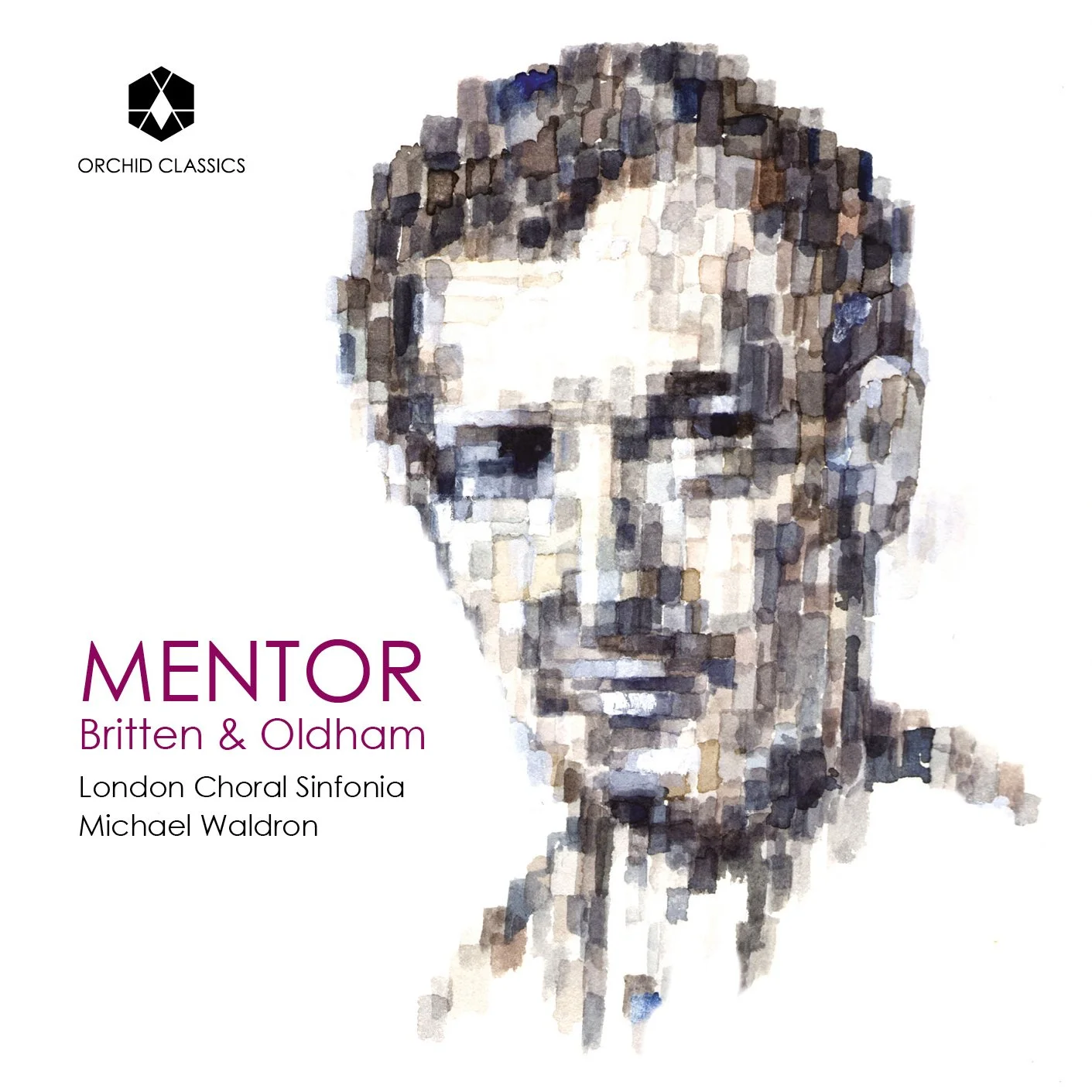
mentor: britten & Oldham
London Choral Sinfonia
Michael Waldron, conductor
Nick Pritchard, tenor
Annemarie Federle, horn
Carolyn Sampson, soprano
Orchid Classics ORC100424
Hats off then to Waldron and his accomplices for taking a much needed look at Oldham’s music - Choir and Organ Magazine, March 2026
This is a model performance, with fine choral singing and committed soloists - British Music Society, April 2026
Fulsomely dispatched by the London Choral Sinfonia - BBC Music Magazine, June 2026
⭐️⭐️⭐️⭐️
It’s terrific - The Arts Desk, June 2026
-
I’ve always loved Britten’s music, and it’s been a strong thread across 10 years of LCS concerts. This recording project, however, fell into place somewhat accidentally. I was skimming the Wikipedia entry on Britten when I came across the following:
“Unlike many leading English composers, Britten was not known as a teacher, but in 1949 he accepted his only private pupil, Arthur Oldham, who studied with him for three years.”
I did a double-take, not realising Britten hadn’t really taught anyone, and secondly not knowing this only acknowledged private pupil was someone I’d never heard of.
Thus began one of my internet ‘deep-dives’, which occupied me for the days and weeks to come. I’ll let George Hall’s excellent programme notes say more about Oldham, but I was immediately captivated by his music. His compositions account for only a relatively small part of his successful and sizeable musical career. Although few in number, I believe his works to be top quality and in all instances – from solo songs to larger works for chorus and orchestra – highly successful. I hope the selection of pieces by Oldham on this disc demonstrates the skill and quality of his work. It’s an original sound, yet one with obvious influences from his famous teacher.
In a happy coincidence I was interested to learn Oldham had prepared the vocal score for Britten’s St Nicolas, a piece I have performed with Nick Pritchard and LCS often. It was a joy to collaborate with Nick and Annemarie – both very keen Britten exponents in their own rights – for the Britten Serenade.
Approaching the Serenade was a daunting task, with no shortage of truly excellent recordings. My friend and mentor, Janice Chapman, sang many roles under Britten and the English Opera Group. She’s always talked very fondly of ‘Ben’, and how he used to get frustrated by people asking him questions about his music in rehearsals. The reply was invariably along the lines of ‘everything you need is on the page’. So, I thought I’d strip the Serenade right back to what’s on the page and build it up from there. The starting point had to be tempi.
I was committed to honouring Britten’s speeds and metronome marks. I came across Walter P. Sterneman’s fascinating research paper online, which goes ultra-forensic on Britten: ‘Composer as Conductor and the Art of Self Interpretation’. This amazing research studies three contemporary recordings of the piece with Britten’s oversight (Britten and Brain – 1944, Goossens and Brain – 1953, Britten and Tuckwell – 1963), and confirmed my suspicions. All three recordings honour the metronome markings of each movement to impressive precision, with the clear exception of the ‘Hymn’. Marked at crotchet = 168-176, it is widely considered unplayable/un-singable at this speed, and Britten himself adjusted this down as far as 151 for the 1944 recording (the later two recordings are both only marginally faster at 160). Of additional interest is the speed of the ‘Dirge’, which I feel has become increasingly sped-up over subsequent decades of live performances and recordings. I was keen to honour the suggested metronome marking, which the three aforementioned recordings all do. It’s steadier than many will be used to, but I feel allows greater clarity and distinction in the huge range of articulation Britten specifies for the string players. I am grateful both Nick and Annemarie were fully behind this too.
Known and loved by choirs across the land, Britten’s Te Deum in C probably gets performed somewhere in a church or cathedral across the land every week of the year. What has been overlooked, however, is that Britten later orchestrated the work (keeping the vocal parts the same, but substituting the organ for strings and harp). It’s surprising this orchestrated version has been almost completely forgotten. The performance history is patchy, and there seems never to have been a full commercial recording until now.
It’s been a real pleasure researching and preparing this project, with a 2026 release honouring the 50th anniversary of Britten’s death, and 100 years since Oldham’s birth.Michael Waldron
TEACHER AND PUPIL: BENJAMIN BRITTEN AND ARTHUR OLDHAM
The most successful British composer of his generation (1913-76), Benjamin Britten scarcely needs any introduction. He shares this album with a much less well-known compositional figure, that of Arthur Oldham (1926-2003), who held the distinction of being Britten’s only pupil.
22 years after his death, Oldham is perhaps best remembered as a chorusmaster – indeed perhaps the finest chorusmaster of his time, a worthy successor to the legendary German Wilhelm Pitz, who was famed above all for his work at Bayreuth and with London’s Philharmonia Orchestra.
But Oldham’s musical career began as a composer. Following a serious breakdown in 1954, he resumed composition two years later, having managed to secure the first of several choral appointments that would see him lauded to the skies by many of the leading conductors of his day.
Benjamin Britten, of course, was something of a prodigy whose initial path into the musical profession was famously smooth: his extraordinary talents were quickly recognised and nurtured.
Composed between 11 July and 17 September 1934 and one of Britten’s earliest works to be published – he was just 21 at the time – the initial version of the Te Deum in C, for treble solo, SATB choir and organ, was written – as the score informs us – ‘for Maurice Vinden and the Choir of St Mark’s, N. Audley Street, London’.
The first performance, though, was not given by the St Mark’s choir but at St Michael’s, Cornhill, on November 13 1935 by the St Michael’s Singers and organist George Thalben-Ball, with a soprano (not treble) soloist, May Bartlett, all conducted by Harold Darke.
In 1936 the BBC commissioned an orchestral version for harp and strings. Britten played viola in the first performance, given at the Mercury Theatre, London, on January 27 1936 by the Choir of St Alban the Martyr conducted by Reginald Goodall. The combination of simplicity and sophistication in Britten’s setting, and its flexible approach to tempo, give this short but highly effective setting distinctiveness.
Much later, in 1961, the composer would add a Jubilate (SATB and organ) as a companion piece to the original setting.
Works such as the Variations on a Theme of Frank Bridge (premiered at the 1937 Salzburg Festival) and the opera Peter Grimes (Sadler’s Wells, 1945) brought Britten international attention. Composed in between these two, the Serenade for Tenor, Horn and Strings was written at the request of the great horn player Dennis Brain, who gave the first performance at London’s Wigmore Hall on 15 October 1943, with Peter Pears the vocal soloist and Walter Goehr conducting a small string ensemble.
To its dedicatee, the critic Edward Sackville-West, Britten explained that ‘the subject is Night and its prestigia: the lengthening shadow, the distant bugle at sunset, the Baroque panoply of the starry sky, the heavy angels of sleep; but also the cloak of evil – the worm in the heart of the rose, the sense of sin in the heart of man. The whole sequence forms an Elegy or Nocturnal (as Donne would have called it), resuming the thoughts and images suitable to evening.’
The Prologue and Epilogue are scored for solo horn, exploiting only the natural harmonics of the instrument – thus lending a curiously ‘out of tune’ quality to these movements. Britten’s settings of texts ranging from Ben Jonson and Anon to Tennyson, meanwhile, are realised with extraordinary musical imagination.
Thirteen years younger than Britten, Arthur Oldham consistently spoke well of his teacher, calling him ‘an immensely good man’, who took him on as a pupil having been badgered by the latter to look through and comment on some early songs. Unlike Britten, Oldham’s professional path was not an easy one.
Born in London, as a child his musical interests were discouraged by both his parents. He was just 12 years old when his elderly father died and 14 when his depressed mother committed suicide. He soon abandoned his placement with a foster family to sleep in a storeroom at his school.
Things took an upturn with a scholarship to the Royal College of Music (1943-5) that saw him study with Herbert Howells and win a Cobbett Prize for a piano trio. More remarkable still was his period of private study (1944-52) with Benjamin Britten; during these years he was very much taken under his teacher’s wing, also assisting the elder composer on such projects as the preparation of vocal scores and arrangements.
On their publication in 1951 Oldham dedicated his Five Chinese Lyrics (1945) to Britten and Pears ‘in deepest gratitude for so many wonderful performances’: the duo would record three of them for Decca in 1956.
After the company had successfully performed his ballet Mr Punch at Sadler’s Wells in July 1946, Dame Marie Rambert offered Oldham the musical directorship of Ballet Rambert. He was just 19. At this period other pieces by him were being featured in the programme of the Aldeburgh Festival.
Unfortunately, a combination of overwork and heavy drinking, plus criticism of Oldham’s new version of Thomas Arne’s 18th-century ballad opera Love in a Village, staged at Aldeburgh in 1952 by the English Opera Group, led to a breakdown and his temporary departure from the musical scene; ironically, the negative comments centred on the influence of his celebrated teacher: ‘once Britten, twice shy,’ wrote one waggish reviewer.
The result of this breakdown was that Oldham spent two years as a studio attendant at Broadcasting House, ‘cleaning carpets, emptying ashtrays, pouring water for announcers. I wrote nothing.’
Reaching a particularly low point at the age of 29, he converted to Roman Catholicism and moved to a Dominican Priory where he worked in the kitchen.
Slowly but steadily an inner renewal began, and in 1956, at the suggestion of an old BBC colleague, Father Agnellus Andrew, head of Catholic religious broadcasting at the BBC, Oldham applied for and was appointed to the post of choirmaster at St Mary’s Catholic Cathedral, Edinburgh, discovering a new vocation to go alongside composition.
This would prove to be the first of a series of choirmaster appointments that would eventually see him regarded throughout Europe as the leading figure in that field, with conductors of the stature of Carlo Maria Giulini and Sir Georg Solti among the first to praise his work (he had gained some experience of the job when working with Britten). Some years later he assumed the post of chorusmaster of Scottish Opera – recently founded by conductor Alexander Gibson – in 1964, remaining for 10 years.
We hear choral works from this period of renewal, notably the Laudes Creaturarum – a cantata on a text of St Francis of Assisi for soprano solo, upper-voice chorus, SATB chorus, strings and organ (1961). It is a setting of St Francis of Assisi’s famous canticle dating from around 1225, a hymn of thanksgiving that derives partly from Psalm 148 and partly from the Beatitudes and which calls on Brother Sun, Sister Moon and other elements to praise the Lord.
Oldham set the original text in Umbrian dialect for Spode Music Week, a festival founded in 1954 at Spode House in Staffordshire that still continues to bring together professional and amateur musicians to focus on music from the Catholic liturgical tradition. (The event moved from Spode House in 1988 and in 2023 settled at Nettlecombe Court in Somerset.)
The Scottish music critic Conrad Wilson eloquently described the piece in 1965. ‘St Francis of Assisi’s poem in praise of all God’s creation is spread over ten short movements, with praise for the moon exquisitely poured out by the solo soprano, praise for the wind taking the form of a striking canon for the girls’ choir, and praise for all those who suffer patiently (again with a soprano solo) revealing, vividly and movingly, the depth of feeling that Oldham’s music has been steadily gaining’.
Spare, clean textures and sounds recalling much earlier periods of musical history are contrasted and combined with brighter, more lively and spicier contemporary ideas, the whole producing, overall, a sense of constant childlike wonder, music suitable for both song and dance brought together in a hymn of praise.
Two other short pieces written a few years later are heard. Simple and homophonic in style, Remember, O thou man for soprano solo and SATB is perhaps Oldham’s best known work. The text is taken from the 17th-century musician Thomas Ravenscroft’s collection Melismata (1611).
In three sections, Oldham’s piece presents almost a pastiche of the music of the period of the text. The slow first section in G minor represents a kind of ‘call and response’ structure, initially with solo voices alternating with full choir, then at the end entirely choral. This alternates with a faster, Allegro con spirito section in more jubilant mode, which leads to a clear close in E flat major.
The text of Sacerdos et Pontifex for mixed chorus and organ (1963) is designated for the entrance of a Roman Catholic Bishop, Archbishop or Cardinal. In this
instance it was dedicated to the Most Reverend Thomas Joseph Gray, appointed Archbishop of St Andrews and Edinburgh in 1951 and subsequently Apostolic Administrator of Aberdeen (1963: for which occasion this joyous processional piece was written) and finally Cardinal-Priest of Santa Chiara e Vigna Chiara in Rome (1969) until his retirement in 1985.
In 1965, with Oldham’s reputation steadily rising, when festival director Lord Harewood, Director of the Edinburgh International Festival, together with Gibson, planned to programme Mahler’s immensely demanding choral Eighth Symphony for the opening night of that year’s event, they approached Oldham to found and train a new chorus that would be up to the task.
Thus was created the Edinburgh Festival Chorus, which quickly established an international reputation, working with such international figures as Herbert von Karajan, Daniel Barenboim, Leonard Bernstein and Claudio Abbado.
In parallel with these regular engagements, between 1969 and 1976 Oldham took on the post of chorusmaster with the London Symphony Chorus, achieving an excellence that would be recognised with three Grammy awards.
In 1976 and at Barenboim’s request he began to travel regularly to Paris to found and train the Choeur de l’Orchestre de Paris, with which he worked exclusively from 1994; another challenging Edinburgh highlight had come in 1992, with a performance by the amateur ensemble of Schoenberg’s serial twelve-note opera, Moses und Aron. In 1980 the Concertgebouw Orchestra in Amsterdam also knocked at his door to ask him to found the ensemble’s own chorus.
Connections with Britten were restored, most memorably in a 1965 Edinburgh performance of the War Requiem conducted by Giulini with Britten conducting the chamber orchestra and Oldham conducting his cathedral boys (he also chorus mastered the main choir). For Oldham, this concert was ‘one of the greatest and most memorable occasions of my musical career’.
In 1971, while in charge of the London Symphony Chorus, Oldham had the pleasure of working again with Britten on the latter’s recording of Elgar’s The Dream of Gerontius. Oldham believed this to be the finest and most faithful recording of the great work.
Following his recovery, meanwhile, Oldham’s resumption of composition saw him produce a stream of mainly choral and often religious works, including mass settings, carols and anthems. Among the most notable of his choral pieces were the Psalms in Time of War, written for the 1977 Edinburgh Festival, and Le Testament de Villon (1996) which celebrated his 20 years in charge of the Chorus of the Orchestre de Paris. He retired in 2002 and died in the Parisian suburb of Villejuif the following year.© George Hall, 2025